
Franklin County City Directory Collections
Columbus Metropolitan Library, or CML, is the central local custodian for the historical Columbus shelf. Its Local History & Genealogy division holds Columbus directories dating to 1841 at Main Library. The cataloged Columbus City Directory run covers 1843 through 1889, including 1843/44, 1848, and 1850/51 issues with brief city histories. The library describes the later street-address section as beginning in 1911. That difference matters: earlier books usually begin with a name, while later books can begin with a street and number.
These collections describe Columbus, not a complete countywide roll. Treat the year printed on the volume as the time frame for its entry. The table separates each source's purpose so a map, a directory, and a deed are not made to answer the same question.
| Collection | Years | Where Held | Access |
|---|---|---|---|
| Columbus City Directories | Dating to 1841; cataloged 1843-1889 | CML Main Library, Local History & Genealogy | Annual alphabetical entries; onsite holdings and selected scans |
| Street-address directory section | Begins 1911 | Later Columbus directory volumes at CML | Street-to-occupant route, then alphabetical entry |
| Digitized City Directory Collection | Project aims toward most directories dating to the 1840s | CML Digital Collections | Online browsing; digitization remains in progress |
| Sanborn and other property maps | Sanborn 1887, 1891, 1901, 1921, and 1921-51 | Main Library, online and microfilm holdings | Building and lot context, not an occupant list |
Note: Record the volume title, year, page or scan, and the alphabetical or street section before comparing another source.
Columbus City Directories at Main Library
The CML Local History & Genealogy service is at Main Library, 96 S. Grant Avenue. Main Library browsing does not require an appointment. The service also offers a one-hour consultation and an Ask a Librarian path. Its third-floor collection guide describes more than 85,000 books and microfilm items, 7,000 published family histories, city and county directories, yearbooks, atlases, maps, cemetery material, naturalization, military, vital, probate, will, and land resources.
The directory shelf is only one part of that research environment. A missing volume can be checked against microfilm or other onsite holdings. Staff can help identify whether a known year is available, but a researcher still needs to read and cite the volume itself. CML also provides up to six free obituary requests each month, a useful way to test a dated directory lead against a death notice.
The Local History & Genealogy desk shows the Franklin County city directory research setting.
Use the library desk as the fallback when an online directory year is absent or an abbreviation needs to be checked in the original volume.
Franklin County City Directory Scans
CML's Digitized City Directory Collection is an in-progress project intended eventually to include most of the library's directories dating to the 1840s. It also includes early Franklin County telephone directories. Remote access is helpful for browsing a surname or comparing a known address, but the project wording does not support assuming every Main Library year has been scanned.
For each image, preserve what the source actually displays: title, publisher when printed in that volume, year, page or scan number, and the exact entry text. Do not fill in a missing publisher from memory. A gap should lead back to the Local History desk, where the physical volume, microfilm, or another local copy may be available.
The digitized collection provides an online view of Franklin County city directory material.
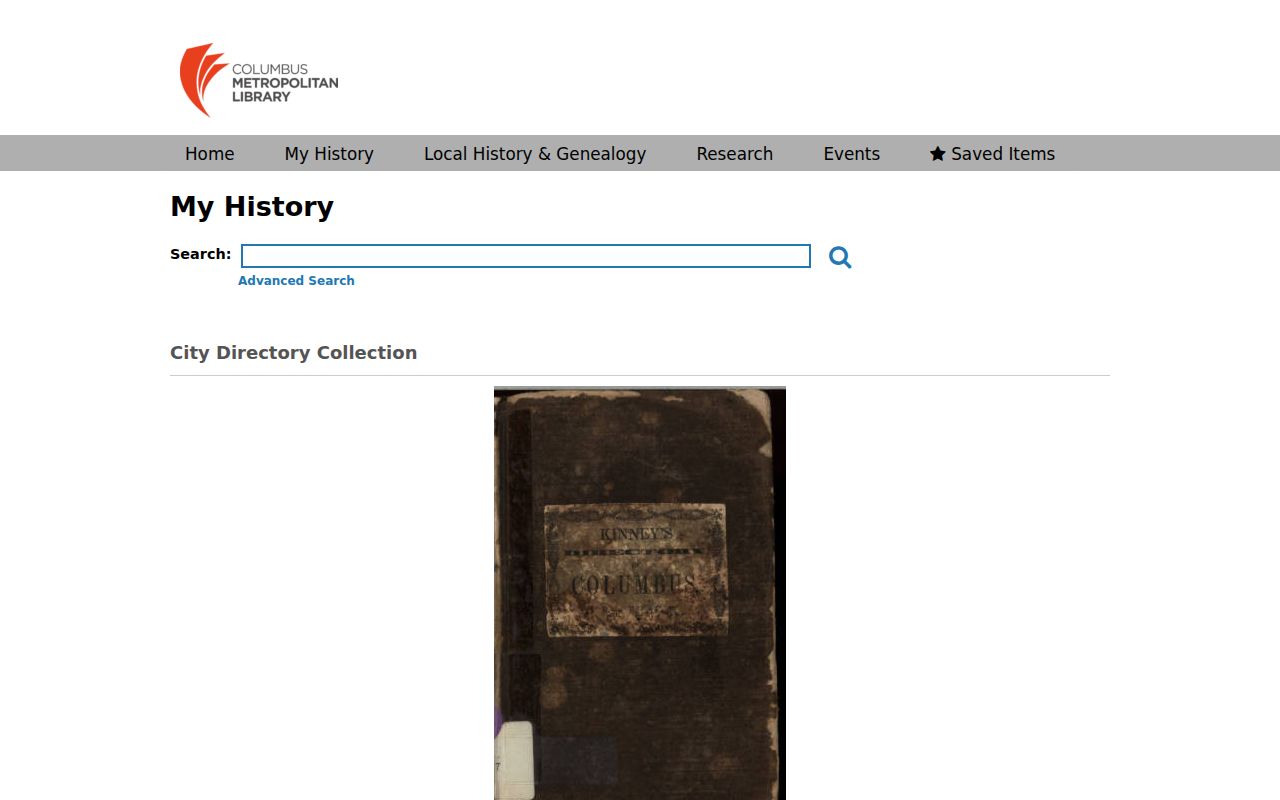
The scan is a research lead, while the complete citation makes the finding usable when another person checks the same directory.
Reading Franklin County City Directory Entries
An annual directory normally prints a resident's name, city address, and often an occupation. The accessible collection description does not provide one complete transcribed entry for every year, so the safest inventory stays with the fields CML identifies. Read abbreviations as printed and photograph or copy the volume's key when it is present. The address is a period address, not proof that the person owned the property.
| Published name | Preserve initials, spelling, and name order as the volume prints them. |
|---|---|
| Address | The city address in the directory's publication or canvass period. |
| Occupation | Often present in the annual entry, according to the CML house-history guide. |
| Street entry | From 1911, a house-by-street-address section can lead to a named occupant. |
| Citation detail | Title, year, page or scan, section, and exact notation from the image. |
- Criss-cross directory
- A reverse arrangement that starts with a street address and points to the named occupant in later volumes.
- Householder index
- An alphabetical arrangement used to locate a household name before checking its printed address.
- Abbreviation key
- The volume's explanation of its shorthand; preserve it because meaning can vary by edition.
Note: A directory identifies an occupant for that edition, so verify an ownership claim with a Recorder deed record.
The CML house-history guide explains how a Franklin County city directory entry fits into a property trail.
That distinction keeps a useful directory finding from becoming an unsupported statement about legal title.
The 1911 Franklin County Directory Pivot
The 1911 Columbus directory introduced a section listing houses by street address. For a Columbus property inside the city limits, turn first to that street section in a post-1911 book, note the occupant, and then find the alphabetical entry for the published name, occupation, and wording. The method is a reverse route from address to a historic occupant. It is especially useful when an old deed or map supplies a street and number but no surname.
Before 1911, the approach changes. Start with a possible surname in the alphabetical portion, or narrow candidates using the Recorder, an atlas, or a property clue. CML also holds bridge material such as a 1926 telephone book arranged by street name, the 1929-30 Dreher's Simplex Street and House Number Guide, and a 1944 Columbus/vicinity telephone book. Cite an exact object, title, and year rather than treating those sources as uninterrupted county coverage.
A current name question needs a different record trail. The Franklin County resident lookup route uses current official custodians and date-compatible checks.
Maps Beside Franklin County City Directories
Maps add physical context to a dated directory entry. CML lists Columbus Sanborn Insurance Maps for 1887, 1891, 1901, 1921, and 1921-51. They are available online and at Main Library on microfilm, with hard copies for 1921-51. The library also identifies the Caldwell atlas of 1872; Baist atlases for 1899, 1910, and 1920; the Modie & Kilmer atlas of 1910; and a Franklin Survey Company plat book for 1937.
A map can show a building footprint, material, lot, or development setting. It cannot establish who lived there. Pair the map with a directory for a period occupant and with Recorder or Probate material for a legal owner or estate connection. This three-part check is more reliable than reading a name into a map symbol.
The CML genealogy and obituary resources connect directory research to maps, newspapers, and family-history tools.
Bring the map year and directory year together before drawing conclusions about a building or household.
Trace Franklin County City Directory Households
Following a household works best as a dated sequence, not as a search for one perfect entry. Census schedules are public under the federal 72-year rule, and the newest decennial schedule available for public genealogy use in 2026 is 1950. A census is a snapshot for its own date. Do not project its household composition forward or backward to cover years a directory does not show.
- Locate a first plausible name or address in a Columbus directory and record the complete citation.
- Check nearby annual volumes for changes in the printed name, address, or occupation.
- For 1911 and later, use the street section to test the address, then return to the alphabetical entry.
- Pair a directory year with an available census year, map, permit, or recorded instrument from a compatible period.
- Use an obituary, newspaper, or Probate lead only after the name, date, and address trail agree.
A disappearance can reflect a move, death, a changed spelling, a listing choice, or a gap in the available run. Historic Columbus newspapers on Main Library microfilm, the Columbus News Index, and Probate records can help test those possibilities. The News Index covers local-interest articles from 1960-1997 and obituaries from 1934-1997; Dispatch electronic editions begin in July 1985.
Franklin County City Directory Gaps
When CML's online collection lacks a desired volume, ask Local History & Genealogy whether the physical book, microfilm, or an alternate copy is available. CML's research service includes in-person book appointments and online expert appointments. The library is the first local fallback for Columbus directory, yearbook, newspaper, map, and house-history questions, while the county Recorder and Probate Court remain the custodians for their own record books.
The Ohio History Connection Archives & Library is a separate archive-level channel. It supports research on Ohio death certificates from 1908-1970, has a catalogue and research appointments, and maintains broader state archival materials. It does not replace CML's city-directory shelf. A search should name the record type and period instead of assuming an archive has a single name index.
The Columbus Historical Society Collections page is another appointment-based route for named people, topics, or collections.
The society reports that its general collection is temporarily closed during its Engine House No. 6 move and storage reorganization, so confirm appointment status before planning a visit.
Franklin County Directory Research Expands
Historical research around a Franklin County city directory gained two recent CML developments. In November 2025, the library announced digital scans of Columbus Dispatch issues from 1986-2018, adding to its keyword-searchable 1871-1985 archive and its text-only 1985-present resource. A name, street address, occupation, or business clue from a directory can help frame a careful newspaper search, but the original article and date should always be read before making a claim.
In December 2025, CML announced its two-millionth My History digitized item. The collection contains central Ohio images, documents, maps, and artifacts, rather than an official person index. These expansions offer more contextual material around a documented directory entry. They do not turn a historical directory into a current residents list.