
Find Franklin County Resident Records
Use a Franklin County residents directory trail that fits the starting fact. An address belongs first in the Auditor's property search. A recorded transfer belongs with the Recorder. A marriage, estate, or name-change question belongs with Probate. Court files belong with the Clerk that maintains that court. A historical Columbus address belongs with the Library's directory collection. Each result is a lead, not a complete profile of a person or household.
Franklin County has separate current, historic, and court record systems. Compare two date-compatible facts before relying on a name match: a parcel number and instrument date, a case number and party role, or a directory year and address. A listed owner can have a different mailing address from the parcel's site address. A directory occupant is not automatically the owner.
- Start an address question in Franklin County Auditor Property Search and save the parcel ID, site address, and legal-description wording.
- Use the matching role and date to query Recorder Cloud Search for a document party, subdivision, document number, or legal description.
- For a precise registration question, use ElectionLink with the required identity and address details.
- For a past Columbus household, check a dated directory at Columbus Metropolitan Library, then compare maps, deeds, and census material from the same period.
- When the online record ends, ask the actual custodian for a named non-exempt record or a copy under the Ohio Public Records Act.
Franklin County Resident Records Offices
Franklin County offices hold different slices of a residents directory. The Auditor maintains the current parcel inventory. The Recorder maintains real-property instruments. The Board of Elections offers a narrow person-specific voter search. The Clerk and Probate Court keep separate court records. These are direct access points, not one combined resident database.
Franklin County Recorder
373 S. High Street, 18th Floor
Columbus, OH 43215
614-525-3930
Official Records Search
Franklin County Auditor
County property and parcel records
Columbus, Ohio
Property search online
Auditor Property Search
Franklin County Board of Elections
1700 Morse Road
Columbus, OH 43229
614-525-3100
Board of Elections
For a full address-by-address sequence, use the Franklin County by-street directory. That route separates parcel evidence from a recorded document and does not turn either into a household list.
Franklin County Parcel Search Routes
The Auditor is the Franklin County starting point when a current address or listed owner is known. Its portal offers Owner Name, Address, Parcel ID, Subdivision & Condo, Map Search, and Intersection Search routes. Owner searching uses LastName FirstName; a partial name or * wildcard is allowed, while quote marks should be omitted. The public inventory carries a current-as-of notice, so it should be verified against the underlying instrument when the transfer itself matters.
| Franklin County field | How it works | Why it matters |
|---|---|---|
| Owner Name | Last name first, partial terms and wildcards accepted | Find a listed owner or spelling variant |
| Address | Dedicated address route | Find parcel and building-address context |
| Parcel ID | All or part, no dashes, wildcard accepted | Carry the durable parcel reference forward |
| Map or Intersection | Dedicated map routes | Place a parcel in its street context |
See the Auditor Property Search interface below. The owner mailing field is correspondence information. The site, or situs, address locates the parcel. Neither statement alone identifies everyone who may live there.
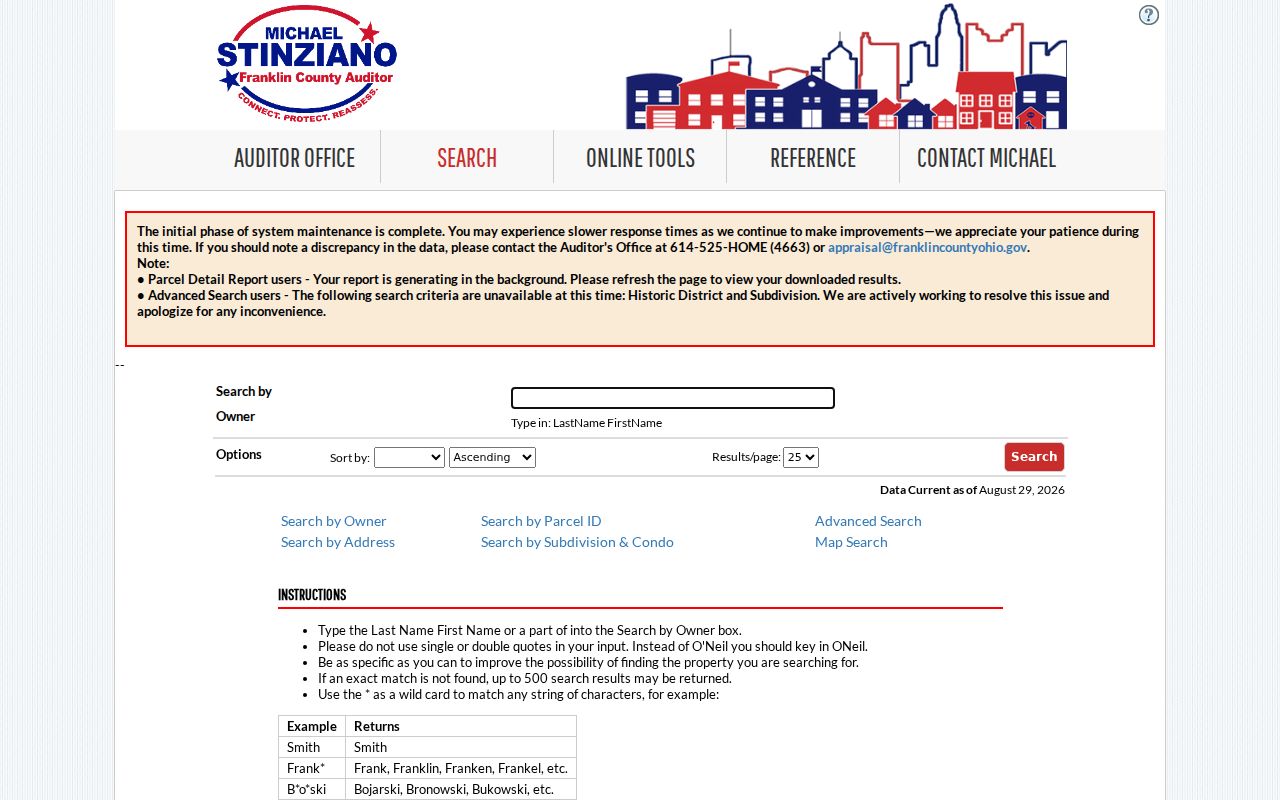
The visible navigation makes the Franklin County parcel route concrete: choose the starting field first, then keep the parcel ID and legal-description clues for the next custodian.
Franklin County Recorder Name Trails
The Recorder's public records index is a Franklin County document trail, not an ordinary address directory. Cloud Search accepts a grantor, grantee, subdivision, document type, or document number as its Search Term. It also provides a recorded-date range and index-only or full-text OCR scope. Multiple words are treated individually in index-only search and as a phrase in full-text search.
Franklin County's Recorder advises that street addresses are not index values. Start with the parcel's legal description, current transfer clue, or named party, then look for a candidate instrument. A grantor is the party conveying an interest; a grantee receives it. Follow a deed chain only when the legal description, subdivision, or parent parcel stays continuous. Cloud Search permits searching without registration, though access to particular functions can differ.
- Parcel
- A county inventory unit for land or a building, usually linked to an address and map.
- Index
- A searchable list of record references, not necessarily the record image or a certified copy.
- Grantor and grantee
- The parties on a recorded conveyance, used to move backward or forward through a title chain.
- Legal description
- The lot, subdivision, condominium, or other legal wording that ties an instrument to land.
The Recorder Cloud Search screenshot shows the public entry point. A document hit should be compared with the Auditor parcel and the selected record image or Recorder copy route.
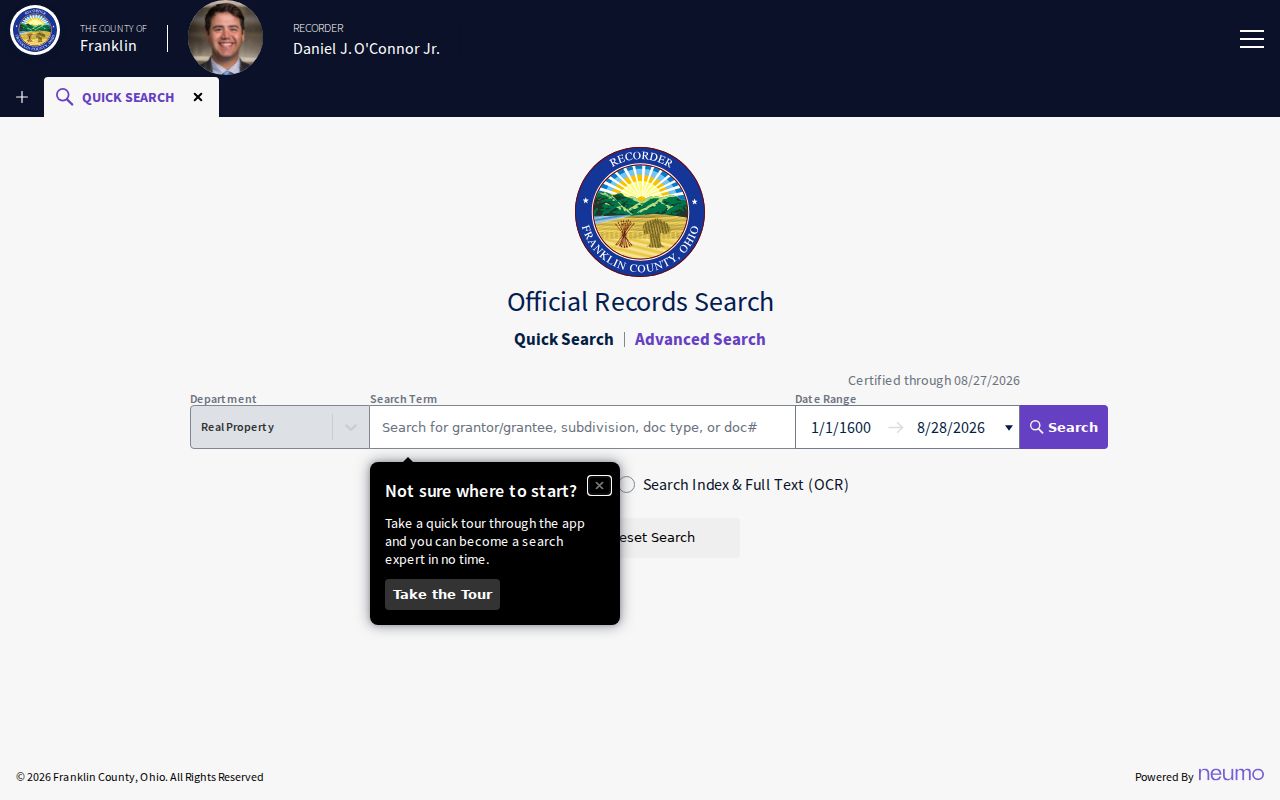
That sequence keeps a Franklin County residents directory search tied to the question the document can actually answer: a recorded party or transfer, not present occupancy.
Current Franklin County Resident Sources
Current Franklin County directory-like sources each identify a defined relationship. The property roll lists current parcel facts. ElectionLink is a personal confirmation form, not a street browser. Recorder results show parties to recorded real-estate documents. Court and Probate systems show their own public case or record context. A name appearing in one source should be checked against another source with the same time and place.
| Franklin County source | What it can establish | Custodian | Access route |
|---|---|---|---|
| Property Search | Listed owner, parcel, site and mailing distinction | Auditor | Public web inventory |
| ElectionLink | Person-specific registration confirmation | Board of Elections | Name, birth year, house number, verification |
| Cloud Search | Recorded real-property party or instrument | Recorder | Index, archive, counter help |
| Case Information Online | Public Common Pleas, domestic, or appeal docket context | Clerk of Courts | Online plus Clerk record route |
| Probate records | Marriage, estate, guardianship, or name-change trail | Probate Court | Index, certified desk, counter |
ElectionLink requires a first name, last name, birth year, house number, and a verification box. Use the official Franklin County voter search only for that precise task. A no-match can reflect a changed name or address, wrong county, inactive or protected status, and is not proof that a person never lived in Franklin County.
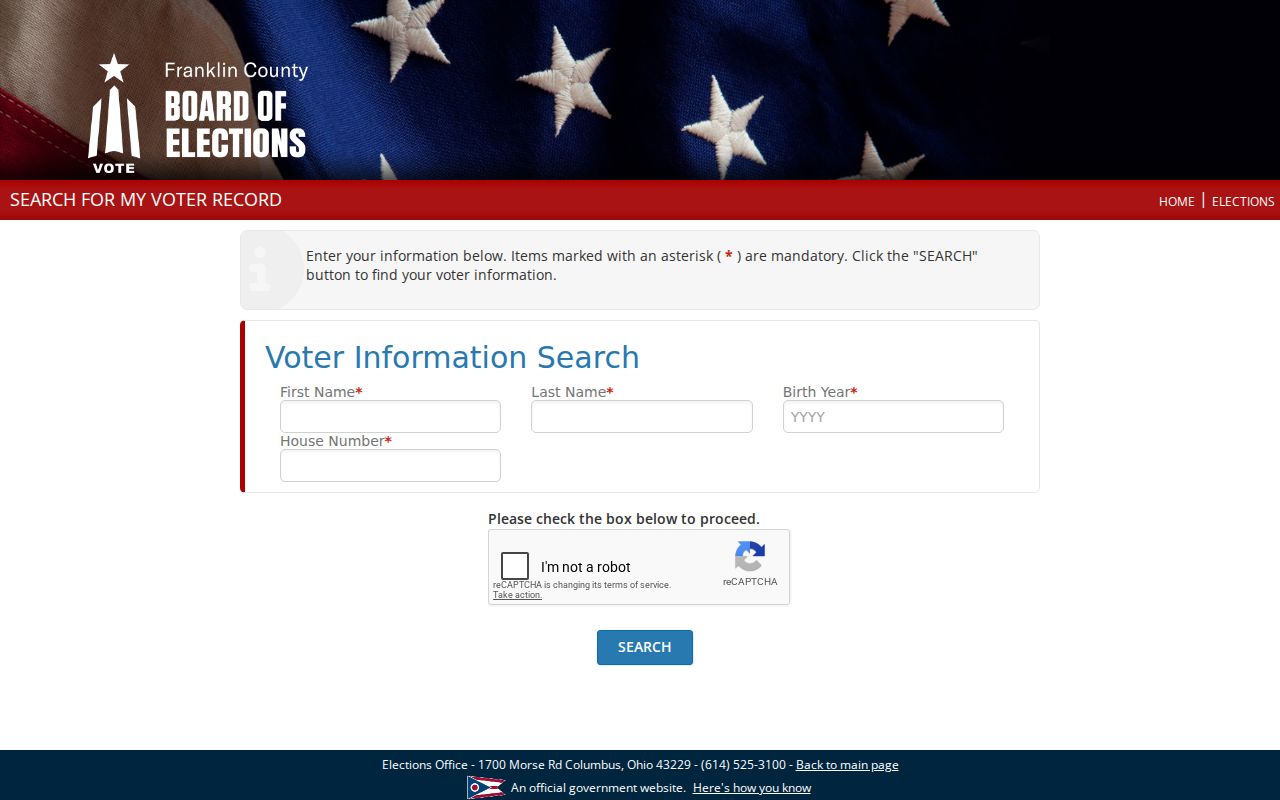
The form's narrow inputs show why a voter record is a confirmation channel rather than a Franklin County browseable resident directory.
Franklin County Court Record Custodians
Franklin County court records are divided by court and subject. The Common Pleas Clerk's Case Information Online covers public Common Pleas General Division criminal and civil, Domestic Relations, and Tenth District appellate case information. Municipal Court uses a separate Clerk CASE Network. Probate holds marriages, estates, guardianships, name changes, and historical vital records. A court result is not an identity conclusion until the party role, case number, court, and dates fit the known facts.
Common Pleas CIO accepts name fields, Court, a year-plus-case-type-plus-case-number route, party role, attorney number, and filing dates. Its online docket is a copy of the docket, while the courthouse file remains the official record. Open the Common Pleas CIO entry for a particular public case rather than guessing from a name-only result.
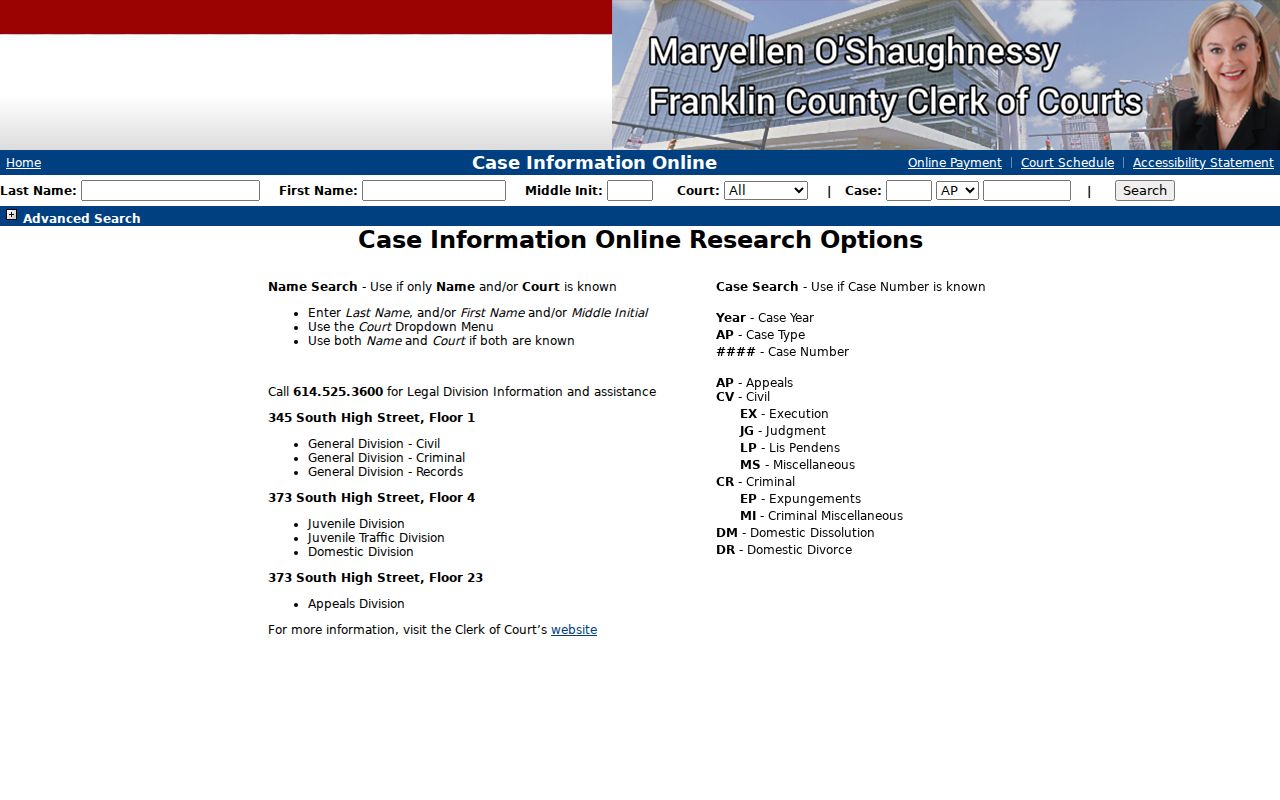
The visible CIO fields support a focused case search and a Clerk copy request when a permitted official record is needed.
Municipal CASE Network searches by first and last name, case number, ticket number, or company name. A case number or ticket is usually the most efficient route. Probate marriage searching and certified-record requests run through the Court's own systems. Confidential, sealed, adoption, mental-health, and developmental-disability records stay outside a routine Franklin County residents directory search.
The Municipal Clerk CASE Network is distinct from Common Pleas. Its separate interface is shown here, so a case or court-date question reaches the proper local Clerk.
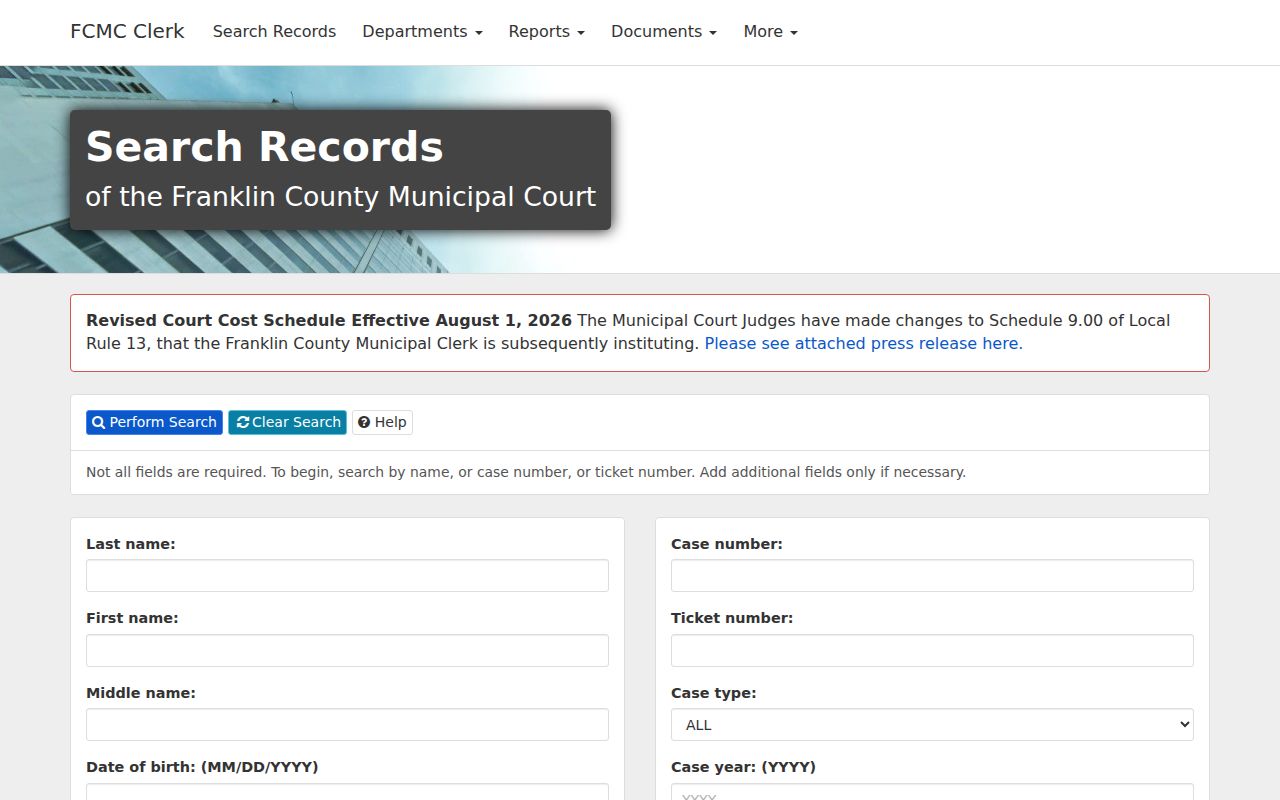
The court's separate search channel reinforces the need to identify the custodian before treating any result as current or complete.
Franklin County Probate and Vital Paths
Franklin County Probate is a valuable bridge for family-history research. It holds births and deaths from 1867 through 1908, marriage records from 1803 to the present, and estate, guardianship, and name-change files from 1898 onward. The online marriage index covers licenses from January 3, 1995 forward. Older marriage records use the Court's counter and certified-record route.
For birth and death records, the event year controls the custodian. Columbus Public Health is a local registrar route, and Ohio Department of Health Vital Statistics is the statewide route. Ohio History Connection supplies historical death-index and archive research for defined periods. Probate's General Case Index is useful for a specific estate or case lead, but confidential record categories remain confidential.
The Probate index interface is shown below. Use an exact name and year where available, then request an allowed copy from the court instead of inferring details from an index line.
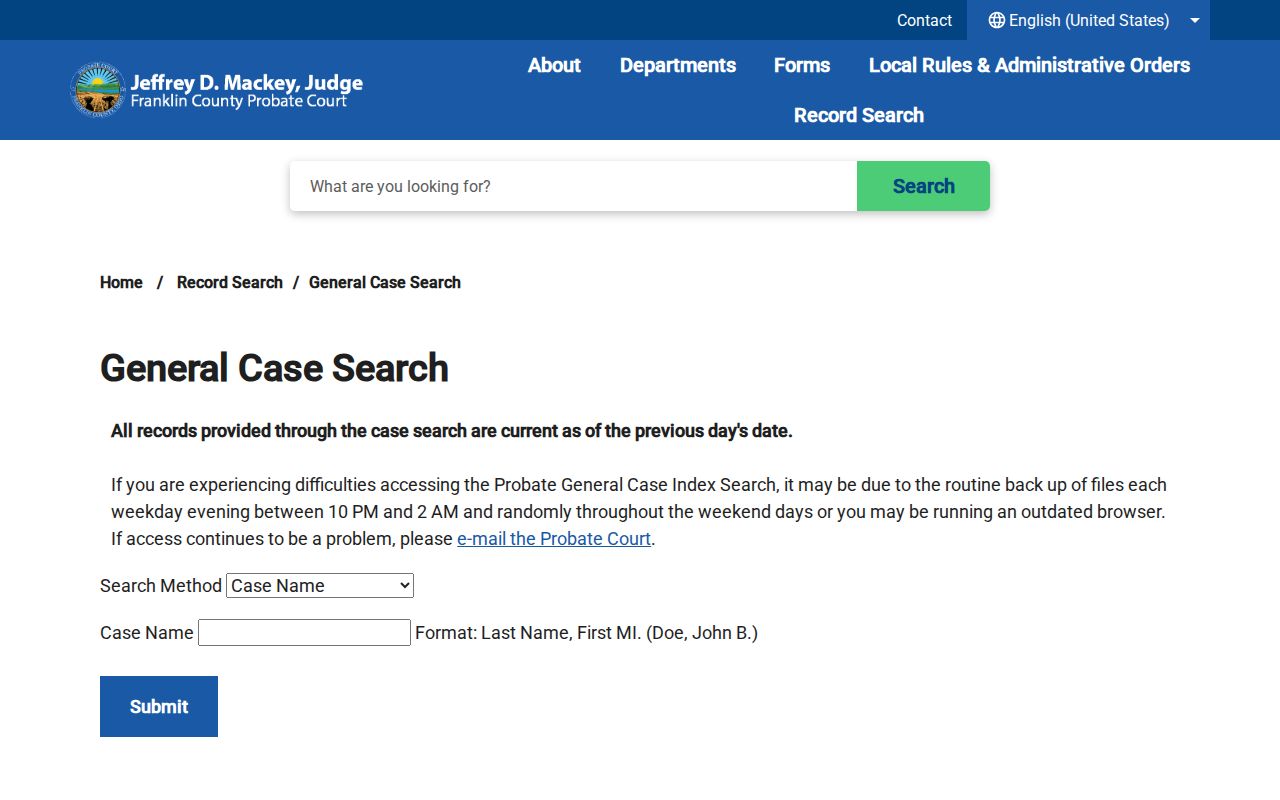
Probate's record roles and dates make it a more useful Franklin County route for an estate or marriage question than a broad current-person search.
Franklin County Privacy Boundaries
Ohio law makes many public records available, but it also protects defined information. Ohio Revised Code § 149.43 is the Ohio Public Records Act. Voter data has its own limits in Chapter 3503, including exclusions for phone, email, Social Security and driver-license information, protected-worker addresses, confidential voters, and other protected fields. A records request should describe the non-exempt record sought with reasonable specificity.
Ohio Safe at Home gives qualified participants an address-confidentiality route. A redaction or no-result can therefore be lawful and intentional. See the Ohio Safe at Home program for eligibility and application-assistant information. Do not use nearby parcels, voter details, delivery information, or historic entries to defeat that protection.
The official Safe at Home information is a reminder that access limits are part of an accurate Franklin County residents directory workflow.
Franklin County Historical Resident Directories
Columbus Metropolitan Library's Local History & Genealogy division at Main Library holds Columbus city directories dating to 1841. The Library's digital City Directory Collection is growing toward most volumes dating to the 1840s, but it does not stand in for every physical or microfilm volume. For a missing year, staff can help locate a volume, microfilm, or another onsite copy.
From 1911 onward, the Columbus directories include houses by street address. That makes a later volume useful for address-to-occupant research, followed by the alphabetical entry for spelling, occupation, or notation. An occupant entry is period evidence, not a deed. The full collection method belongs in the Franklin County city directories page.
The CML City Directory Collection offers a remote starting point. Record the title, year, page, section, and exact notation from a scan before making a family-history note.
Franklin County's 1879 Record Gap
Early Franklin County deed research has a local warning that deserves attention. The Recorder's historical-search brochure says some old records were destroyed in the 1879 fire, although most were reconstructed. The office's historic material identifies an 1804–1913 archive search, while the regular deed index begins January 2, 1914 and the mortgage index begins January 7, 1970.
An early missing entry is not conclusive. The documented fallback is a partial surname in the handwritten grantor or grantee index, then a volume and page reference, followed by Recorder staff or archive help with the book, original, or reconstruction. The Recorder's historical-search brochure explains that route. Note: a historic index spelling, fire loss, or reconstructed record can require a second search path.
Franklin County Records Beyond a Portal
A web index is only one access channel. The Recorder accepts questions about copies and historical books at 373 S. High Street, 18th Floor, Columbus, and through its office contact path. The Clerk's counter and records division handle court copies not visible online. Probate has its certified desk. Columbus Building and Zoning Services has an address-history and records-request path for Columbus addresses, while Columbus Metropolitan Library and Ohio History Connection reach historical formats that live portals may not expose.
Use the office that actually maintains the record. For a City of Columbus address, BZS Records Research accepts requests by email, mail, or counter and its form can request Address History, inspection reports, certificates of occupancy, and other listed records. A particular request should name the address, parcel, date range, and desired record. Franklin County offices are not required to create a new list or conduct an open-ended investigation.
Columbus Metropolitan Library's research hub offers historical collections, consultations, and limited obituary requests. Ohio History Connection provides archives and historical vital-record research. The Ohio Public Records Act can be a fallback for a specific non-exempt local record, not a substitute for choosing the right custodian first.
Official Franklin County Sources Compared
Official sources let a researcher see the record's keeper, date, and limits. A commercial compiled-person category may blend information from several sources, but it can be stale, conflated, or unclear about the actual custodian. Start with a Franklin County source when a fact needs to be checked or corrected.
| Source type | Best use | Key limit |
|---|---|---|
| Auditor parcel roll | Current parcel context and listed owner | Mailing address and occupancy are different facts |
| Recorder instrument | Recorded party, transfer, and legal-description evidence | Street address is not the ordinary index field |
| Library directory | Dated historical occupant research | Occupant is not necessarily owner |
| Compiled-person category | May suggest a lead | Source date, accuracy, and custodian can be unclear |
For a correction, contact the source that holds the underlying record. That can be the Auditor for a parcel discrepancy, the Board for voter registration, or the court or Recorder for its own record process. Franklin County record keepers can explain access and copy routes without resolving an uncertain identity match.
Franklin County Official Safety Checks
Public records can also be used to verify an unexpected notice. The Franklin County Recorder's free Property Alert monitors documents recorded against a name, entity, or selected document and sends matching information. It is an alert service, not proof that a recorded document is valid. Preserve the instrument number and date, then contact the Recorder if a document appears suspicious.
For an unexpected court-fine text, the Municipal Court says it does not send text messages about fines or demand QR-code payment. Check a claimed matter through the official Clerk interface rather than a link in the message. The Sheriff's Inmate Information route is a separate current-custody source and does not establish a person's current residence.
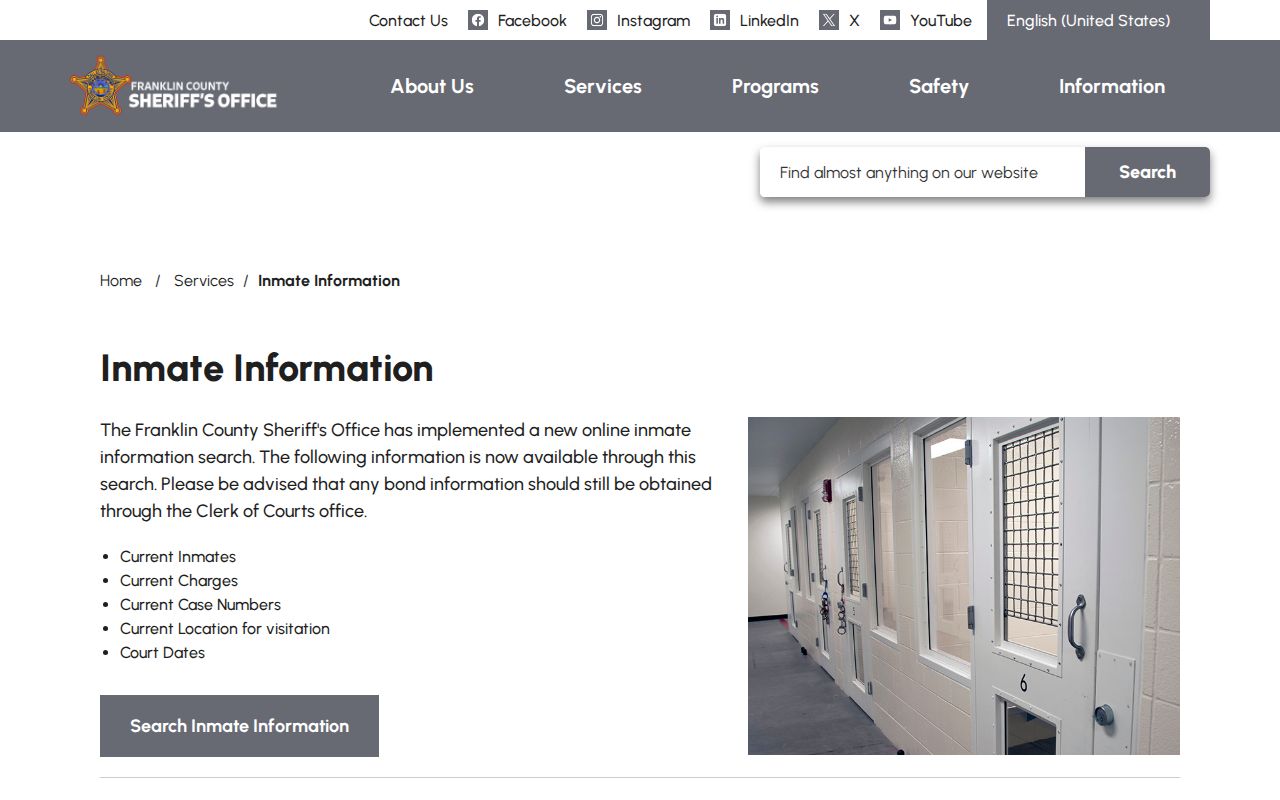
The official Sheriff landing page directs a custody question to its stated category and should be cross-checked with the relevant court record.
Ohio's Department of Rehabilitation and Correction Offender Search is another category-specific state source. Its last-recorded-address caveat means it is not a Franklin County residents directory or a current-location claim.
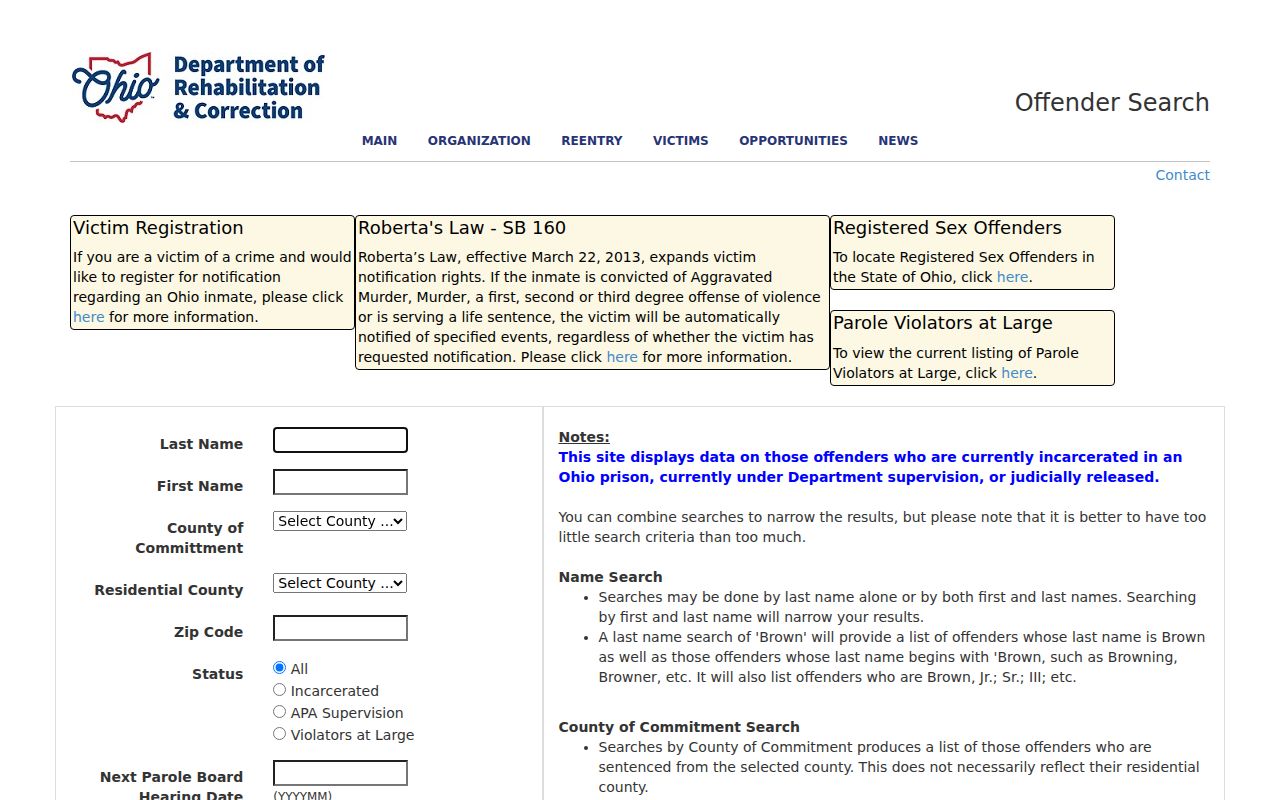
Use an official system only for the record category it states, then verify the record number, date, and custodian before acting on a notice.